Amarna
Virtual asset linked to this landmark

- Virtual owner
- The platform
- Times sold
- 0
- Fame on Wikipedia
- 87,686 article reads in 12 months
- Searches (30 days)
- 0
- Watching
- 0
Virtual ownership only. It gives no legal, financial or physical right in the real landmark. Prices are set by the market and may fall.
About Amarna and its history
Site of the capital founded by the pharaoh Akhenaten and abandoned after his death.
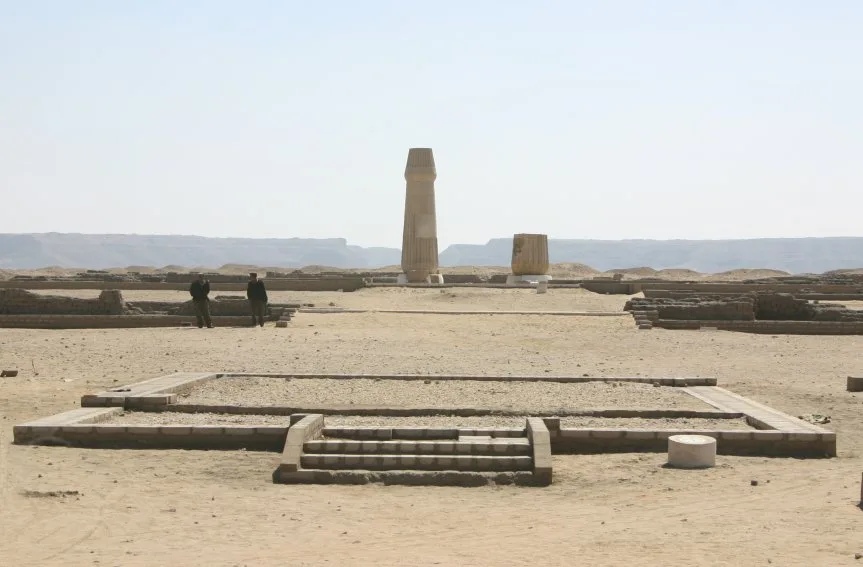
Amarna (; Arabic: العمارنة, romanized: al-ʿAmārna) is an extensive ancient Egyptian archaeological site containing the ruins of Akhenaten (Ancient Egyptian: 𓈌𓏏𓉐𓇋𓏏𓈖𓇳, romanized: ꜣḫt-jtn), the capital city during the late Eighteenth Dynasty. The city was established in 1346 BC, built at the direction of the Pharaoh Akhenaten, and abandoned shortly after his death in 1332 BC.
The site is on the east bank of the Nile River, in what today is the Egyptian province of Minya. It is about 58 km (36 mi) south of the city of al-Minya, 312 km (194 mi) south of the Egyptian capital, Cairo, and 402 km (250 mi) north of Luxor (site of the previous capital, Thebes). The city of Deir Mawas lies directly to its west. On the east side of Amarna there are several modern villages, the chief of which are l-Till in the north and el-Hagg Qandil in the south.
Activity in the region flourished from the Amarna Period until the later Roman era.
Name
The name Amarna comes from the Beni Amran, an Arab tribe that settled the area before the 18th century. The ancient Egyptian name Akhenaten means "the horizon of the Aten".
English Egyptologist Sir John Gardner Wilkinson visited Amarna twice in the 1820s and identified it as Alabastron, following the sometimes contradictory descriptions of Roman-era authors Pliny (On Stones) and Ptolemy (Geography), although he was not sure about the identification and suggested Kom el-Ahmar as an alternative location.
City of Akhetaten
The area of the city was effectively a virgin site, and it was this city that Akhenaten described as the Aten's "seat of the First Occasion, which he had made for himself that he might rest in it".
It may be that the Royal Wadi's resemblance to the hieroglyph for horizon showed that this was the place to found the city.
The city was built as the new capital of the Pharaoh Akhenaten, dedicated to his new religion of worship to the Aten. Construction started in or around Year 5 of his reign (1346 BC) and was probably completed by Year 9 (1341 BC), although it became the capital city two years earlier. To speed up construction of the city most of the buildings were constructed out of mudbrick, and white washed. The most important buildings were faced with local stone.
It is the only ancient Egyptian city which preserves great details of its internal plan in large part because it was abandoned almost completely shortly after the royal government of Tutankhamun quit the city in favor of Thebes (modern Luxor). The city seems to have remained active for a decade or so after his death, and a shrine to Horemheb indicates that it was at least partially occupied at the beginning of his reign, if only as a source for building material elsewhere. Once it was abandoned, it remained uninhabited until Roman settlement began along the edge of the Nile. However, due to the unique circumstances of its creation and abandonment, it is questionable how representative of ancient Egyptian cities it actually is.
Source: Wikipedia · text available under CC BY-SA 4.0
- Built / established
- 14th century BC
- Location
- Minya, Egypt
- Coordinates
- 27.6456, 30.9036
- Category
- Ancient Sites
Source: Wikipedia · Factual information about the real landmark; unrelated to virtual ownership.
Price & ownership history
Landmarks near Amarna
Map → Available
📖 639 reads
Available
📖 639 reads
 Available
📖 35 K reads
Available
📖 35 K reads
 Available
📖 31 K reads
Available
📖 31 K reads
 Available
📖 5 K reads
Available
📖 5 K reads