Ramesseum
Virtual asset linked to this landmark

- Virtual owner
- The platform
- Times sold
- 0
- Fame on Wikipedia
- 43,496 article reads in 12 months
- Searches (30 days)
- 0
- Watching
- 0
Virtual ownership only. It gives no legal, financial or physical right in the real landmark. Prices are set by the market and may fall.
About Ramesseum and its history
The mortuary temple of Ramesses II on Luxor's west bank.
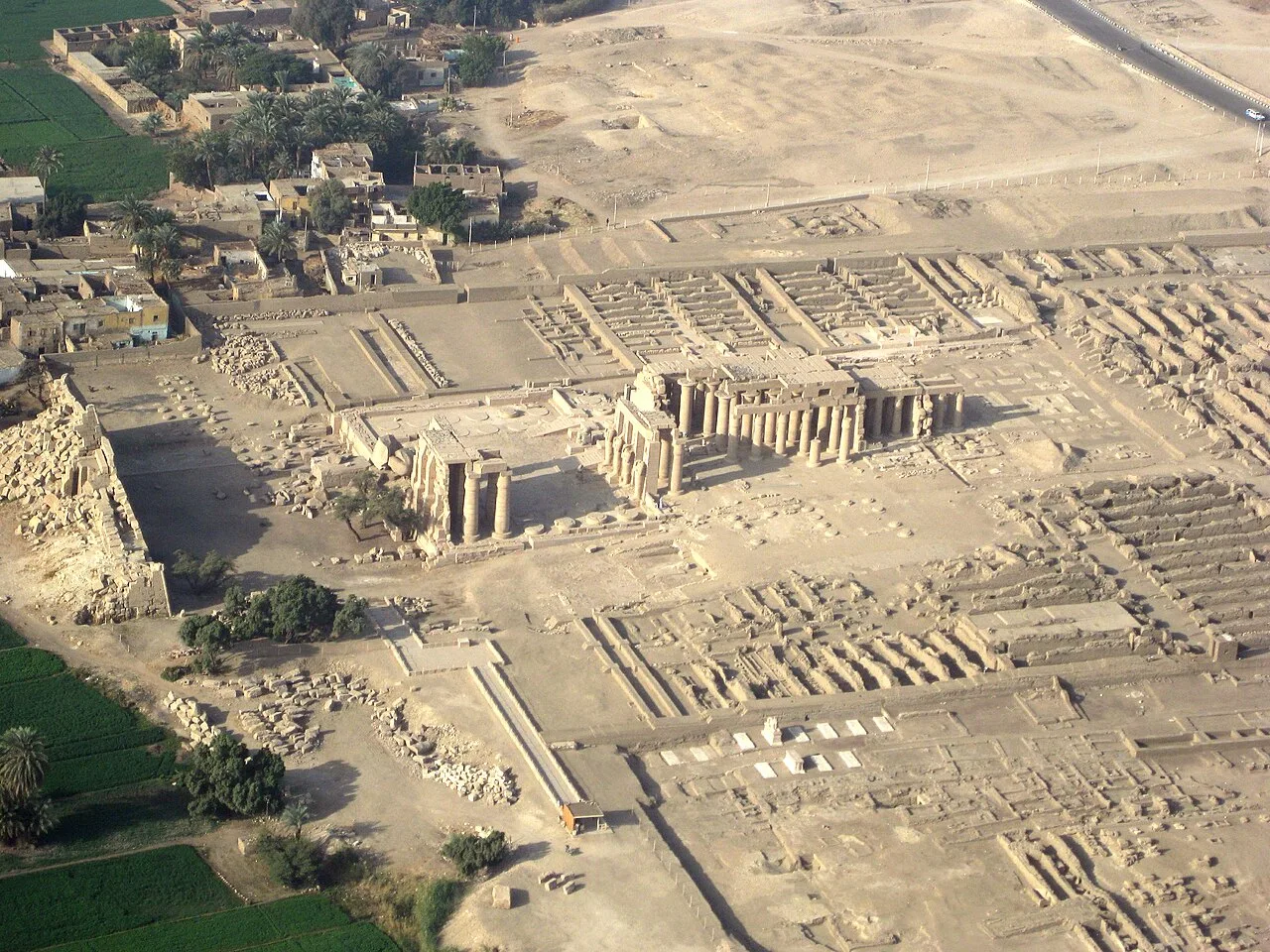
The Ramesseum is the memorial temple (or mortuary temple) of Pharaoh Ramesses II ("Ramesses the Great"). It is located in the Theban Necropolis in Upper Egypt, on the west of the River Nile, across from the modern city of Luxor.
It is the second largest temple in Egypt, occupying an area of c. 10 hectares (1,100,000 sq ft).
It was originally called the House of millions of years of Usermaatra-setepenra that unites with Thebes-the-city in the domain of Amun. Usermaatra-setepenra was the prenomen of Ramesses II.
History
Ramesses II modified, usurped, or constructed many buildings from the ground up, and the most splendid of these, in accordance with New Kingdom royal burial practices, would have been his memorial temple: a place of worship dedicated to pharaoh, god on earth, where his memory would have been kept alive after his death. Surviving records indicate that work on the project began shortly after the start of his reign and continued for 20 years.
The design of Ramesses's mortuary temple adheres to the standard canons of New Kingdom temple architecture. Oriented northwest and southeast, the temple itself comprised two stone pylons (gateways, some 60 metres (200 ft) wide), one after the other, each leading into a courtyard. Beyond the second courtyard, at the centre of the complex, was a covered 48-column hypostyle hall, surrounding the inner sanctuary. An enormous pylon stood before the first court, with the royal palace at the left and the gigantic statue of the king looming up at the back. As was customary, the pylons and outer walls were decorated with scenes commemorating the pharaoh's military victories and leaving due record of his dedication to, and kinship with, the gods. In Ramesses's case, much importance is placed on the Battle of Kadesh (ca. 1274 BC); more intriguingly, however, one block atop the first pylon records his pillaging, in the eighth year of his reign, a city called "Shalem", which may or may not have been Jerusalem. The scenes of the great pharaoh and his army triumphing over the Hittite forces fleeing before Kadesh, as portrayed in the canons of the "epic poem of Pentaur", can still be seen on the pylon.
Unlike the massive stone temples that Ramesses ordered carved from the face of the Nubian mountains at Abu Simbel, the inexorable passage of three millennia was not kind to his "temple of a million years" at Thebes. This was mostly due to its location on the very edge of the Nile floodplain, with the annual inundation gradually undermining the foundations of this temple and its neighbours. Neglect and the arrival of new faiths also took their toll: for example, in the early years of the Christian Era, the temple was put into service as a Christian church.
This is all standard fare for a temple of its kind built at that time.
Source: Wikipedia · text available under CC BY-SA 4.0
- Built / established
- 13th century BC
- Location
- Luxor, Egypt
- Coordinates
- 25.7277, 32.6103
- Category
- Ancient Sites
Source: Wikipedia · Factual information about the real landmark; unrelated to virtual ownership.
Price & ownership history
Landmarks near Ramesseum
Map → Available
📖 6 K reads
Available
📖 6 K reads
 Available
📖 2 K reads
Available
📖 2 K reads
 Available
📖 3 K reads
Available
📖 3 K reads
 Available
📖 8 K reads
Available
📖 8 K reads