Avenue of Sphinxes
Virtual asset linked to this landmark

- Virtual owner
- The platform
- Times sold
- 0
- Fame on Wikipedia
- 14,162 article reads in 12 months
- Searches (30 days)
- 0
- Watching
- 0
Virtual ownership only. It gives no legal, financial or physical right in the real landmark. Prices are set by the market and may fall.
About Avenue of Sphinxes and its history
An ancient processional way about 2.7 km long linking Luxor Temple with Karnak.
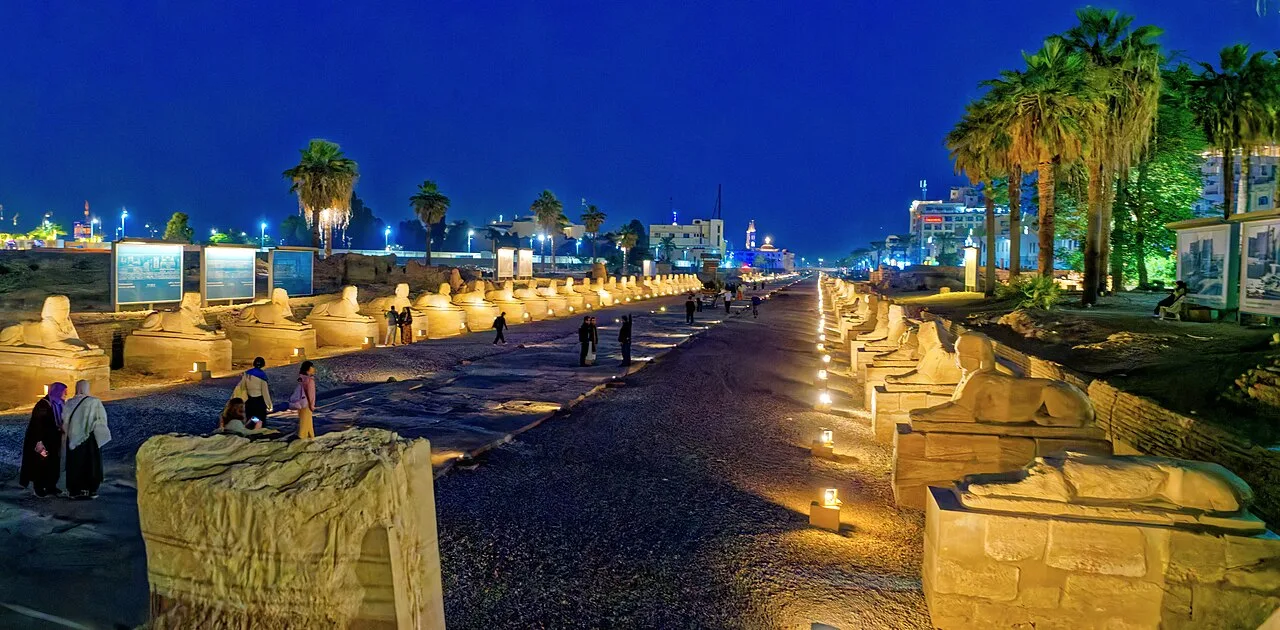
Avenue of Sphinxes or The King's Festivities Road, also known as Rams Road (Arabic: طريق الكباش), is a 2.7 km (1.7 mi) long avenue (dromos) which connects Karnak Temple with Luxor Temple having been uncovered in the ancient city of Thebes (modern Luxor), with sphinxes and ram-headed statues lined up on both flanks.
History
Construction of the Avenue of Sphinxes began during the New Kingdom era and was completed during the Late period during the reign of 30th Dynasty ruler Nectanebo I (380–362 B.C.), the road was later buried under layers of sand over the centuries.
In Description de l'Égypte (1809) the Avenue of Sphinxes is described as 2,000 meters long, lined with over 600 sphinxes.
Georges Daressy reported in 1893 that at Luxor the road is buried and couldn't be excavated because it lay below the groundwater level, whereas at Karnak nearly a kilometer of it is visible.
The first trace of the avenue (at Luxor) was found in 1949 when Egyptian archaeologist Mohammed Zakaria Ghoneim discovered eight statues near the Luxor Temple with 17 more statues uncovered from 1958 to 1961 and 55 unearthed from 1961 to 1964 all within a perimeter of 250 meters. From 1984 to 2000, the entire route of the walkway was finally determined, leaving it to excavators to uncover the road. The original 1,057 statues are along the way, and they are divided into three shapes:
The first shape is a lion's body with a ram's head erected on an area of approximately 1,000 feet between the Karnak temple and the Precinct of Mut during the reign of the ruler of the New Kingdom Tutankhamun.
The second shape is a full ram statue, built in a remote area during the eighteenth dynasty of Amenhotep III, before being transferred later to the Karnak complex.
The third shape which includes the largest part of the statues is a statue of the Sphinx (body of a lion and head of a human), the statues extend over a mile to Luxor Temple.
Source: Wikipedia · text available under CC BY-SA 4.0
- Location
- Luxor, Egypt
- Coordinates
- 25.7085, 32.6480
- Category
- Ancient Sites
Key facts
- It was reopened in a ceremony held in November 2021.
Source: Wikipedia · Factual information about the real landmark; unrelated to virtual ownership.
Price & ownership history
Landmarks near Avenue of Sphinxes
Map → Available
📖 9 K reads
Available
📖 9 K reads
 Owned · buyable
 Available
📖 6 K reads
Available
📖 6 K reads
 Available
📖 2 K reads
Available
📖 2 K reads