Pyramid of Pepi I
Virtual asset linked to this landmark

- Virtual owner
- The platform
- Times sold
- 0
- Fame on Wikipedia
- 8,995 article reads in 12 months
- Searches (30 days)
- 0
- Watching
- 0
Virtual ownership only. It gives no legal, financial or physical right in the real landmark. Prices are set by the market and may fall.
About Pyramid of Pepi I and its history
The Sixth Dynasty pyramid of King Pepi I at South Saqqara; its ancient name Men-nefer gave the city of Memphis its name.
The pyramid of Pepi I (Egyptian: Mn-nfr Ppy, lit. 'Pepi's splendour is enduring') is the funerary monument built for the Egyptian pharaoh Pepi I of the Sixth Dynasty in the 24th or 23rd century BC. The complex lent its name to the ancient capital city of Egypt, Memphis. As in the pyramids of his predecessors, Pepi I's substructure was filled with vertical columns of hieroglyphic texts: Pyramid Texts. It was in Pepi I's pyramid that these texts were initially discovered in 1880 by Gaston Maspero, though they originated in the pyramid of Unas. The corpus of Pepi I's texts is also the largest from the Old Kingdom, comprising 2,263 columns and lines of hieroglyphs.
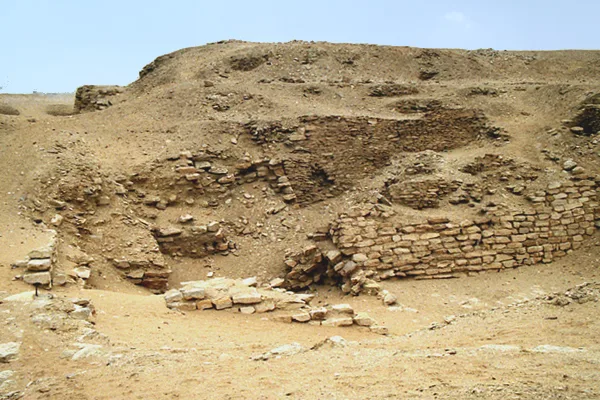
Pepi I sited his pyramid complex in South Saqqara, approximately 2.4 km (1.5 mi) north of Djedkare Isesi's pyramid. It is unclear why he relocated to South Saqqara, but perhaps he had moved the royal palace south and away from the city, or no viable sites remained in North and Central Saqqara after Teti built his pyramid there. Pepi I entrusted one of his wives, Inenek-Inti, with the construction of the funerary monument. The pyramid and substructure replicated the basic design of Djedkare Isesi's and is proportionally very similar. The pyramid has been severely damaged and is now a small ruinous mound. The mortuary temple suffered extensive damage from stone thieves, but the work carried out by the Mission archéologique française de Saqqâra/Mission archéologique franco-suisse de Saqqâra (MAFS) has revealed that the temple was laid out in near exactly the same manner as his predecessor's. Excavation work at the causeway has only extended out to a few metres, and the valley temple and pyramid town remain unexcavated.
The most significant finds at the complex are the queens' pyramids. As of 2017, a total of nine pyramids have been discovered south-west of Pepi I's complex. These pyramids belong to Nebuunet, Inenek-Inti, Meritites IV, Ankhesenpepi II, Ankhesenpepi III, Mehaa with a tomb belonging to her son Hornetjerikhet to its north, Behenu, Reherishefnakht and one, the Western Pyramid, that remains anonymous. The pyramids of Queens Ankhesenpepi II and Behenu also contain Pyramid Texts. The pyramid of Reherishefnakht contains both Pyramid Texts and Coffin Texts. It is significant for two reasons: It is the oldest known pyramid not built for a member of the royal family and its epigraphy links the Old and Middle Kingdoms.
Source: Wikipedia · text available under CC BY-SA 4.0
- Location
- Giza, Egypt
- Coordinates
- 29.8544, 31.2189
- Category
- Pyramids
Source: Wikipedia · Factual information about the real landmark; unrelated to virtual ownership.
Price & ownership history
Landmarks near Pyramid of Pepi I
Map → Available
📖 4 K reads
Available
📖 4 K reads
 Available
📖 17 K reads
Available
📖 17 K reads
 Available
📖 24 K reads
Available
📖 24 K reads
 Available
📖 9 K reads
Available
📖 9 K reads