Pyramid of Djoser
Virtual asset linked to this landmark

- Virtual owner
- The platform
- Times sold
- 0
- Fame on Wikipedia
- 176,655 article reads in 12 months
- Searches (30 days)
- 0
- Watching
- 0
Virtual ownership only. It gives no legal, financial or physical right in the real landmark. Prices are set by the market and may fall.
About Pyramid of Djoser and its history
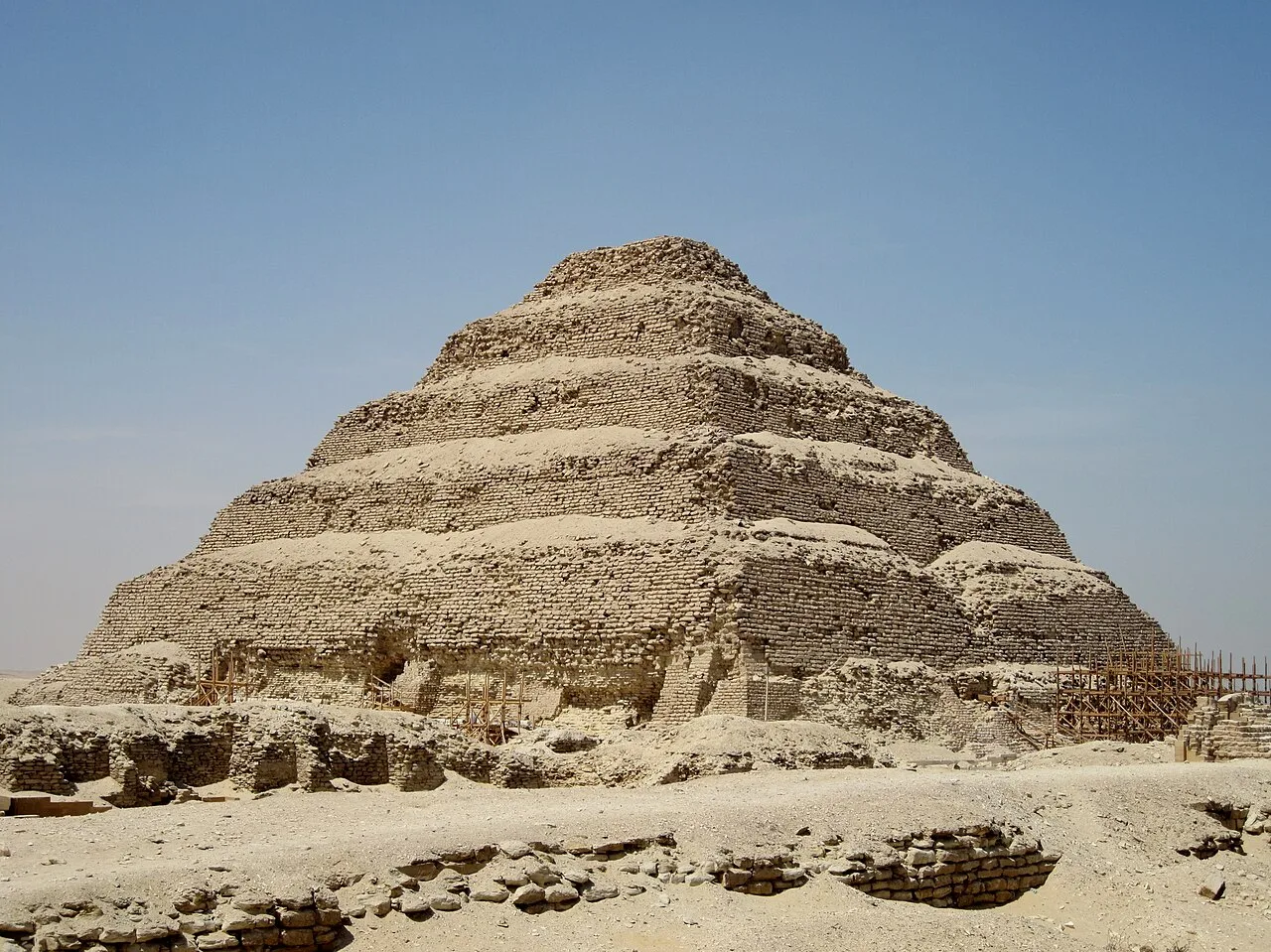
A step pyramid in the Saqqara necropolis built for King Djoser, regarded as Egypt's earliest colossal stone building.
The Pyramid of Djoser, sometimes called the Step Pyramid of Djoser or Step Pyramid of Horus Netjerikhet, is an archaeological site in the Saqqara necropolis, Egypt, northwest of the ruins of Memphis. It was the first Egyptian pyramid to be built. The six-tier, four-sided structure is the earliest colossal stone building in Egypt. It was built in the 27th century BC during the Third Dynasty for the burial of Pharaoh Djoser. The pyramid is the central feature of a vast mortuary complex in an enormous courtyard surrounded by ceremonial structures and decoration.
The pyramid went through several revisions and redevelopments of the original plan. The pyramid originally stood 62.5 m (205 ft; 119 cu) tall, with a base of 109 m × 121 m (358 ft × 397 ft; 208 cu × 231 cu) and was clad in polished white limestone. As of 1997, the step pyramid (or proto-pyramid) was considered to be the earliest large-scale cut stone construction made by man, although the nearby enclosure wall "Gisr el-Mudir" is suggested by some Egyptologists to predate the complex, and the South American pyramids at Caral are contemporary.
In March 2020, the pyramid was reopened for visitors after a 14-year restoration.
Djoser
Djoser was the first or second king of the 3rd Dynasty (c. 2670–2650 BC) of the Old Kingdom of Egypt (c. 2686 – c. 2125 BC). He is believed to have ruled for 19 years or, if the 19 years were biennial taxation years, 38 years. He reigned long enough to allow the grandiose plan for his pyramid to be realized in his lifetime.
Djoser is best known for his innovative tomb, which dominates the Saqqara landscape. In this tomb, he is referred to by his Horus name Netjerikhet; Djoser is a name given by New Kingdom visitors more than a thousand years later. Djoser's step pyramid is astounding in its departure from previous architecture. It sets several important precedents, perhaps the most important of which is its status as the first monumental structure made of stone.
The social implications of such a large and carefully sculpted stone structure are staggering. The process of building such a structure would be far more labor-intensive than previous monuments of mud-brick. This suggests that the state, and therefore the royal government, had a new level of control of resources, both material and human. Also, from this point on, kings of the Old Kingdom are buried in the north, rather than at Abydos.
Although the plan of Djoser's pyramid complex is different from later complexes, many elements persist and the step pyramid sets the stage for later pyramids of the 4th, 5th, and 6th Dynasties, including the great pyramids of Giza. Though the Dynastic Egyptians themselves did not credit him as such, most Egyptologists credit Djoser's vizier Imhotep with the design and construction of the complex.
Source: Wikipedia · text available under CC BY-SA 4.0
- Built / established
- 27th century BC (Third Dynasty)
- Location
- Giza, Egypt
- Coordinates
- 29.8713, 31.2165
- Category
- Pyramids
Key facts
- Its design is attributed to the architect Imhotep.
- It has six tiers and rises about 62 m.
Source: Wikipedia · Factual information about the real landmark; unrelated to virtual ownership.
Price & ownership history
Landmarks near Pyramid of Djoser
Map → Available
📖 9 K reads
Available
📖 9 K reads
 Available
📖 24 K reads
Available
📖 24 K reads
 Available
📖 61 K reads
Available
📖 61 K reads
 Available
📖 17 K reads
Available
📖 17 K reads