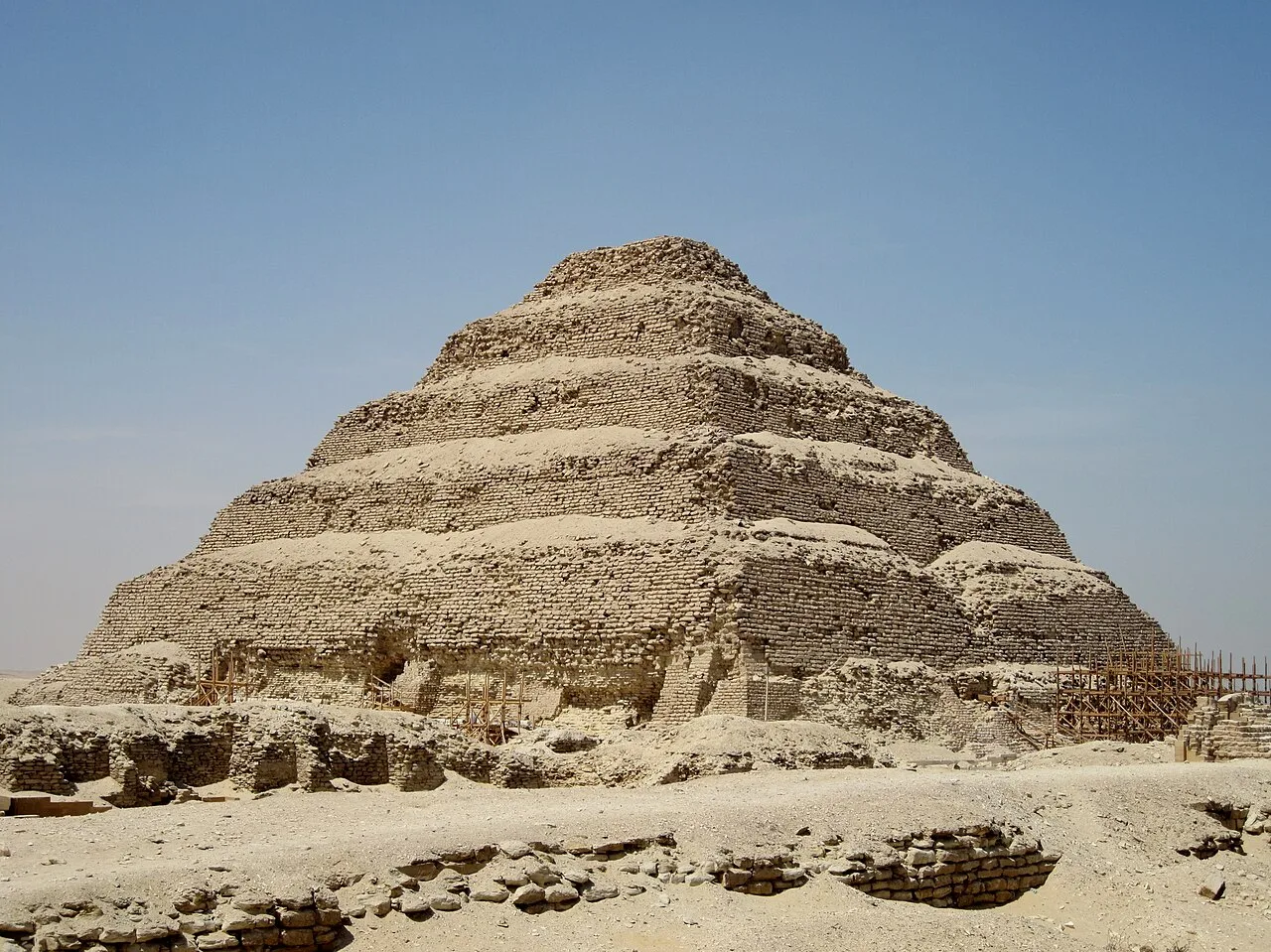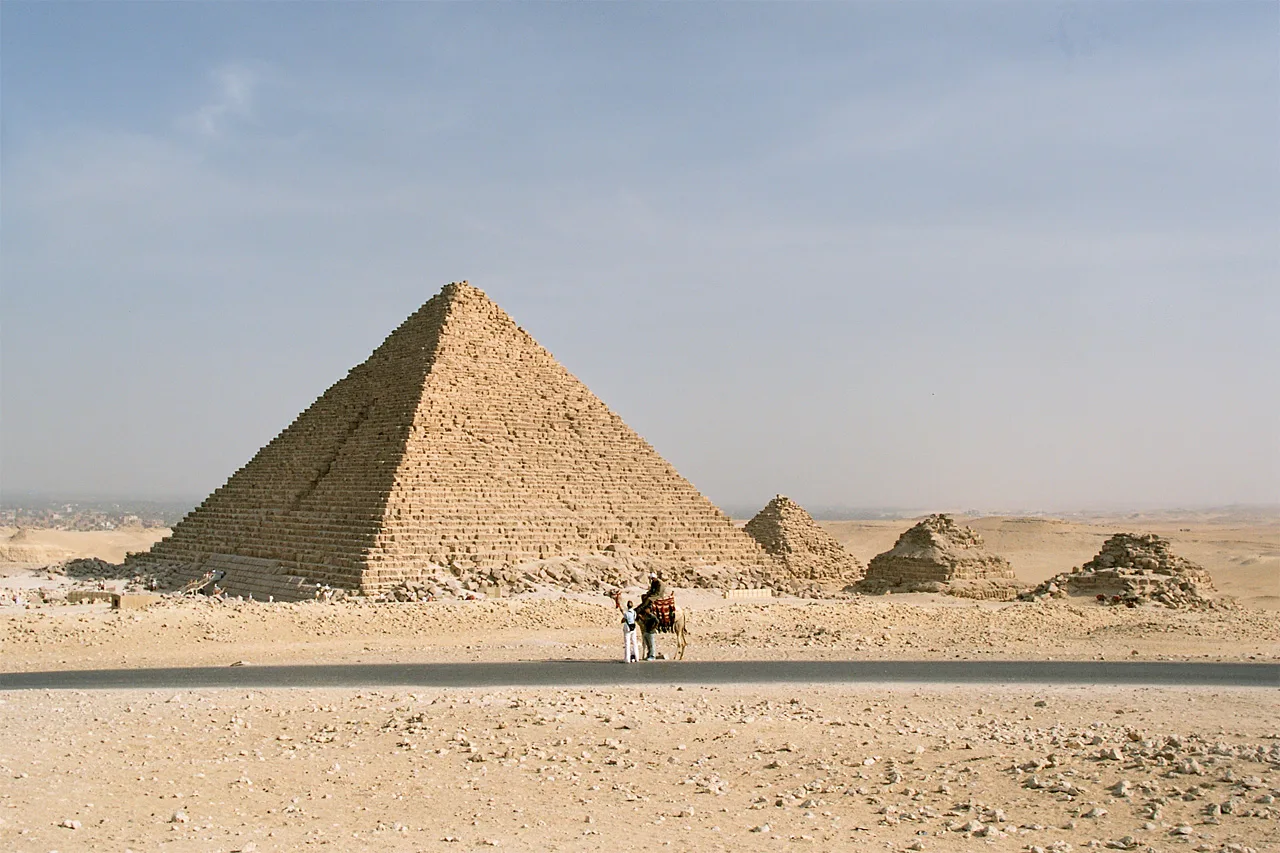
Pyramid of Menkaure
Virtual asset linked to this landmark

- Virtual owner
- The platform
- Times sold
- 0
- Fame on Wikipedia
- 69,364 article reads in 12 months
- Searches (30 days)
- 0
- Watching
- 0
Virtual ownership only. It gives no legal, financial or physical right in the real landmark. Prices are set by the market and may fall.
About Pyramid of Menkaure and its history
The smallest of the three main Giza pyramids, built for Menkaure.
The pyramid of Menkaure (Arabic: هرم منقرع, romanized: Haram Manqaraʿ or Arabic: هرم منكاورع, romanized: Haram Minkāwraʿ) is the smallest of the three main pyramids of the Giza pyramid complex, located on the Giza Plateau in the southwestern outskirts of Cairo, Egypt. It is thought to have been built to serve as the tomb of the Fourth Dynasty King Menkaure. With roughly one tenth of the volume of the pyramid of Khufu, it is a part of a Egyptian pyramid complex comprising a mortuary temple and a valley temple linked by a causeway, together with three subsidiary pyramids on its southern side. Numerous signs of unfinished work indicate that the king died while the monument was still under construction, leaving its completion to his successor Shepseskaf.
Size and construction
Menkaure's pyramid had an original height of 65.5 meters (215 ft), and was the smallest of the three major pyramids at the Giza Necropolis. It now stands at 61 m (200 ft) tall with a base of 108.5 m (356 ft). Its angle of incline is approximately 51°20′25″. It was constructed of limestone and Aswan granite.
As with the pyramid of Khafre, the ground chosen for the monument was uneven, and the builders compensated for this irregularity. Quarrymen cut into the western part of the limestone plateau, extracting large monoliths in a regular, systematic fashion; these were hauled to the eastern and southern sides of the perimeter, close to their point of extraction, where they were dressed and fitted to raise the ground to the level of the pyramid's foundations. The same procedure served for the platform of the mortuary temple and for the corridor leading to the causeway.
The body of the pyramid consists of large blocks of local limestone quarried nearby, laid in regular courses that form steps against which the casing blocks were set. The lowest sixteen courses of the casing, rising to a height of more than 20 metres (66 ft), were of red granite from Aswan; above this the casing was of fine limestone up to the pyramidion, which has disappeared and whose material (limestone or granite) is unknown. The construction of the granite casing was halted at sixteen to eighteen layers following Menkaure's death, only seven of which remain today due to vandalism and erosion. Part of the granite was left in the rough. Medieval quarrying of the pharaonic monuments concentrated on the fine limestone, which explains the loss of the upper casing; in the nineteenth century, part of the granite casing was in turn dismantled on the orders of Muhammad Ali, who reused it for the construction of the arsenal of Alexandria.
The great breach that scars the northern face (cf. below) of the pyramid exposes the internal structure of the monument.
Source: Wikipedia · text available under CC BY-SA 4.0
- Built / established
- c. 2510 BC (Fourth Dynasty)
- Location
- Giza, Egypt
- Coordinates
- 29.9725, 31.1283
- Category
- Pyramids
Key facts
- Its original height was about 65 m.
- Its lower courses were cased in red granite brought from Aswan.
Source: Wikipedia · Factual information about the real landmark; unrelated to virtual ownership.
Price & ownership history
Landmarks near Pyramid of Menkaure
Map → Available
📖 117 K reads
Available
📖 117 K reads
 Available
📖 4 K reads
Available
📖 4 K reads
 Available
 Available
📖 423 K reads
Available
📖 423 K reads