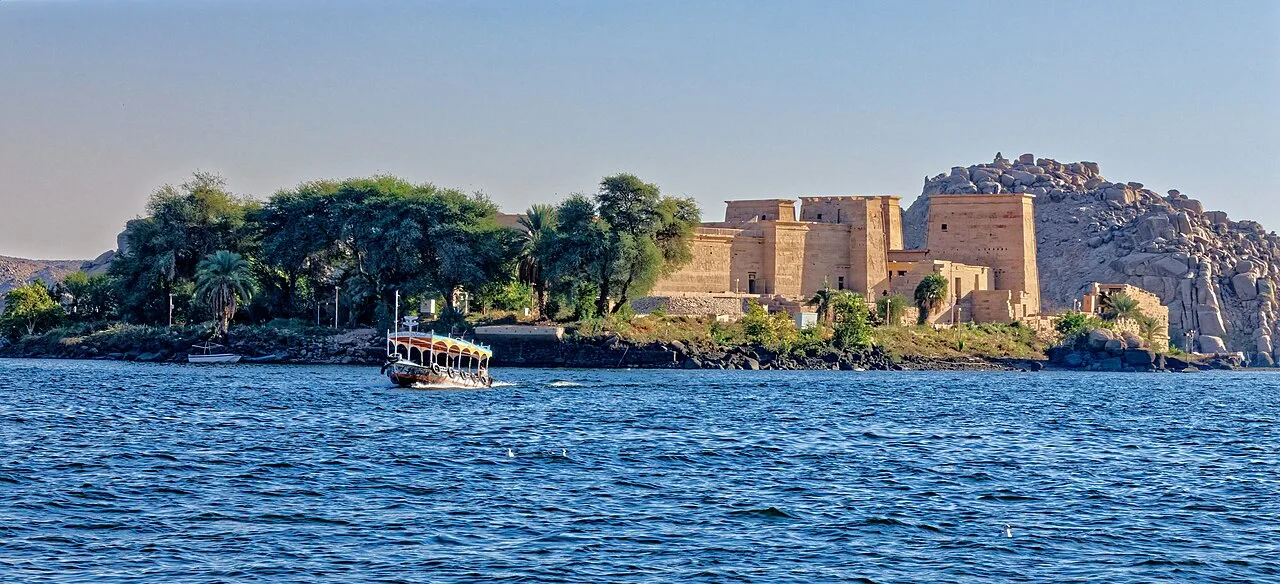
Philae Temple
Virtual asset linked to this landmark

- Virtual owner
- The platform
- Times sold
- 0
- Fame on Wikipedia
- 69,788 article reads in 12 months
- Searches (30 days)
- 0
- Watching
- 0
Virtual ownership only. It gives no legal, financial or physical right in the real landmark. Prices are set by the market and may fall.
About Philae Temple and its history
A temple complex dedicated to the goddess Isis, moved to Agilkia Island to save it from flooding.
The Philae temple complex (; Ancient Greek: Φιλαί or Φιλή and Πιλάχ, Arabic: فيلة Egyptian Arabic: [fiːlæ], Egyptian: p3-jw-rķ' or 'pA-jw-rq; Coptic: ⲡⲓⲗⲁⲕ, ⲡⲓⲗⲁⲕϩ, Coptic pronunciation: [ˈpilɑk, ˈpilɑkh]) is an island-based temple complex in the reservoir of the Aswan Low Dam, downstream of the Aswan Dam and Lake Nasser, Egypt in Africa.
Originally, the temple complex was located on Philae Island, near the expansive First Cataract of the Nile in Upper Egypt. These rapids and the surrounding area have been variously flooded since the initial construction of the Aswan Low Dam in 1902. With the construction of the modern dam in Aswan (1960–1970) a few kilometers upstream, this temple was going to face total flooding and was initially omitted from the Nubia Campaign project to rescue all temples in the area and avoid what had previously happened with the Aswan Low Dam and the Temple of Philae. However, the importance of the monumental complex, formerly known as the Pearl of the Nile, remembered for the description by Pierre Loti in his literary work, La Mort de Philae (1909), led to further commitment from UNESCO member countries, which launched an international competition to save the monuments of Philae.
The solution proposed by a consortium of Egyptian designers prevailed, which involved dismantling the ninety-five monumental structures on the island and reconstructing them at a higher site, 12.40 meters above the original location, by leveling the nearby islet of Agilkia. The contract for the execution of the works was awarded by UNESCO in 1974, through the Egyptian Ministry of Culture, to two Italian companies: Condotte Acque from Rome and Mazzi Estero from Verona, later joined as Condotte-Mazzi Estero S.p.A. The two companies were tasked with documenting, dismantling, and restoring the Philae monumental complex, as well as transferring and reconstructing it at the new site on Agilkia Island. A third Egyptian company, the High Dam Company, which had previously built the Aswan High Dam, was assigned the task of draining the original monumental site and preparing the reinforced concrete foundations and landscaping of Agilkia. The Italian architect Giovanni Joppolo was entrusted with the supervision and responsibility for all operations under the Italian consortium's jurisdiction. The whole operation lasted from 1977 to 1980. The hieroglyphic reliefs of the temple complex are being studied and published by the Philae Temple Text Project of the Austrian Academy of Sciences, Vienna (Institute OREA).
Source: Wikipedia · text available under CC BY-SA 4.0
- Built / established
- Mostly Ptolemaic period
- Location
- Aswan, Egypt
- Coordinates
- 24.0254, 32.8843
- Category
- Ancient Sites
Source: Wikipedia · Factual information about the real landmark; unrelated to virtual ownership.
Price & ownership history
Landmarks near Philae Temple
Map → Available
 Available
 Available
📖 3 K reads
Available
📖 3 K reads
 Available
📖 48 K reads
Available
📖 48 K reads