Abu Qir Bay
Virtual asset linked to this landmark

- Virtual owner
- The platform
- Times sold
- 0
- Fame on Wikipedia
- 9,574 article reads in 12 months
- Searches (30 days)
- 0
- Watching
- 0
Virtual ownership only. It gives no legal, financial or physical right in the real landmark. Prices are set by the market and may fall.
About Abu Qir Bay and its history
A bay east of Alexandria where ancient sunken cities lie.
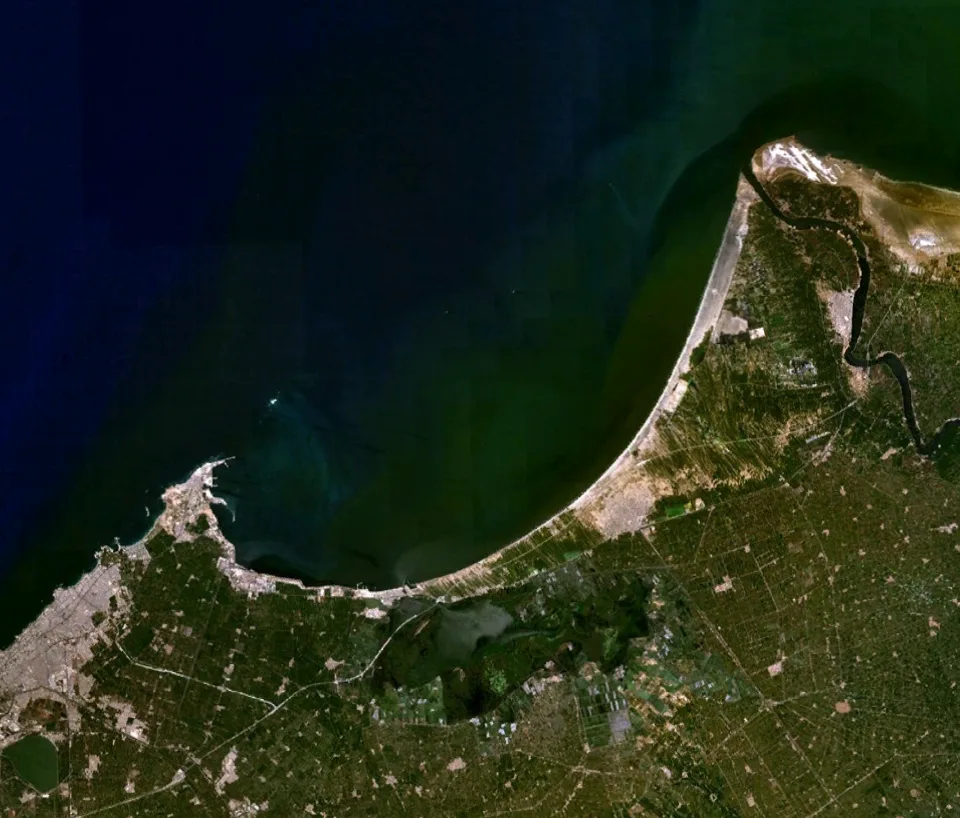
The Abū Qīr Bay (sometimes transliterated Abukir Bay or Aboukir Bay; Arabic: خليج أبو قير, romanized: Khalīj Abū Qīr) is a spacious bay on the Mediterranean Sea near Alexandria in Egypt, lying between the Rosetta mouth of the Nile and the town of Abu Qir. The ancient cities of Canopus, Heracleion and Menouthis lie submerged beneath the waters of the bay. In 1798 it was the site of the Battle of the Nile, a naval battle fought between the British Royal Navy and the navy of the French First Republic. The bay contains a natural gas field, discovered in the 1970s.
Geography
Abu Qir Bay lies approximately 20 kilometres (12 mi) east of Alexandria, bounded to the southwest by the Abu Qir headland, on which lies the town of Abu Qir, and to the northeast by the Rosetta mouth of the Nile. The bay is a highly fertile Egyptian coastal region but suffers from acute eutrophication and pollution from untreated industrial and domestic waste. The ABU QIR Fertilizers and Chemicals Industries Company, a large producer of nitrogen fertilizer, is located on the bay.
Land submersion
Classical sources indicate that the Canopic branch of the Nile Delta once entered the sea in the vicinity of Heracleion or the eastern part of Canopus. A combination of Islamic texts and investigation using geoarchaeology suggest that this branch was still in existence in the eighth century, when a major inundation caused eastern Canopus to sink into the bay. The Canopic branch subsequently declined and eventually became closed.
Land in the area of Canopus was subject to rising sea levels, earthquakes, tsunamis, and large parts of it seem to have already succumbed to soil liquefaction sometime at the end of the 2nd century BC, becoming submerged.
Antiquities
In ancient times Abu Qir Bay was surrounded by marshland and contained several islands. As early as the 7th century BC, port cities were established on the bay. The bay now contains the underwater archaeological sites of three cities from the pre-Hellenistic, Hellenistic and Roman periods. The eastern part of ancient city of Canopus is submerged in the bay, along with the remains of Menouthis and its sister-city Herakleion–Thonis which now lies 7 kilometres offshore. They were excavated by French underwater archaeologist Franck Goddio.
In November 2017, the Egyptian mission in cooperation with the European Institute for Underwater Archaeology announced the discovery of 2.000-year-old three sunken shipwrecks dated back to the Roman Era in Alexandria's Abu Qir Bay.
The sunken cargo included a royal head of crystal perhaps belong to the commander of the Roman armies of “Antonio”, three gold coins from the era of Emperor Octavius Augustus, large wooden planks and pottery vessels.
Source: Wikipedia · text available under CC BY-SA 4.0
- Location
- Alexandria, Egypt
- Coordinates
- 31.3200, 30.0700
- Category
- Beaches & Dive Sites
Source: Wikipedia · Factual information about the real landmark; unrelated to virtual ownership.
Price & ownership history
Landmarks near Abu Qir Bay
Map → Available
📖 48 K reads
Available
📖 48 K reads
 Available
 Available
📖 22 K reads
Available
📖 22 K reads
 Available
📖 4 K reads
Available
📖 4 K reads