Myos Hormos (Quseir al-Qadim)
Virtual asset linked to this landmark

- Virtual owner
- The platform
- Times sold
- 0
- Fame on Wikipedia
- 7,962 article reads in 12 months
- Searches (30 days)
- 0
- Watching
- 0
Virtual ownership only. It gives no legal, financial or physical right in the real landmark. Prices are set by the market and may fall.
About Myos Hormos (Quseir al-Qadim) and its history
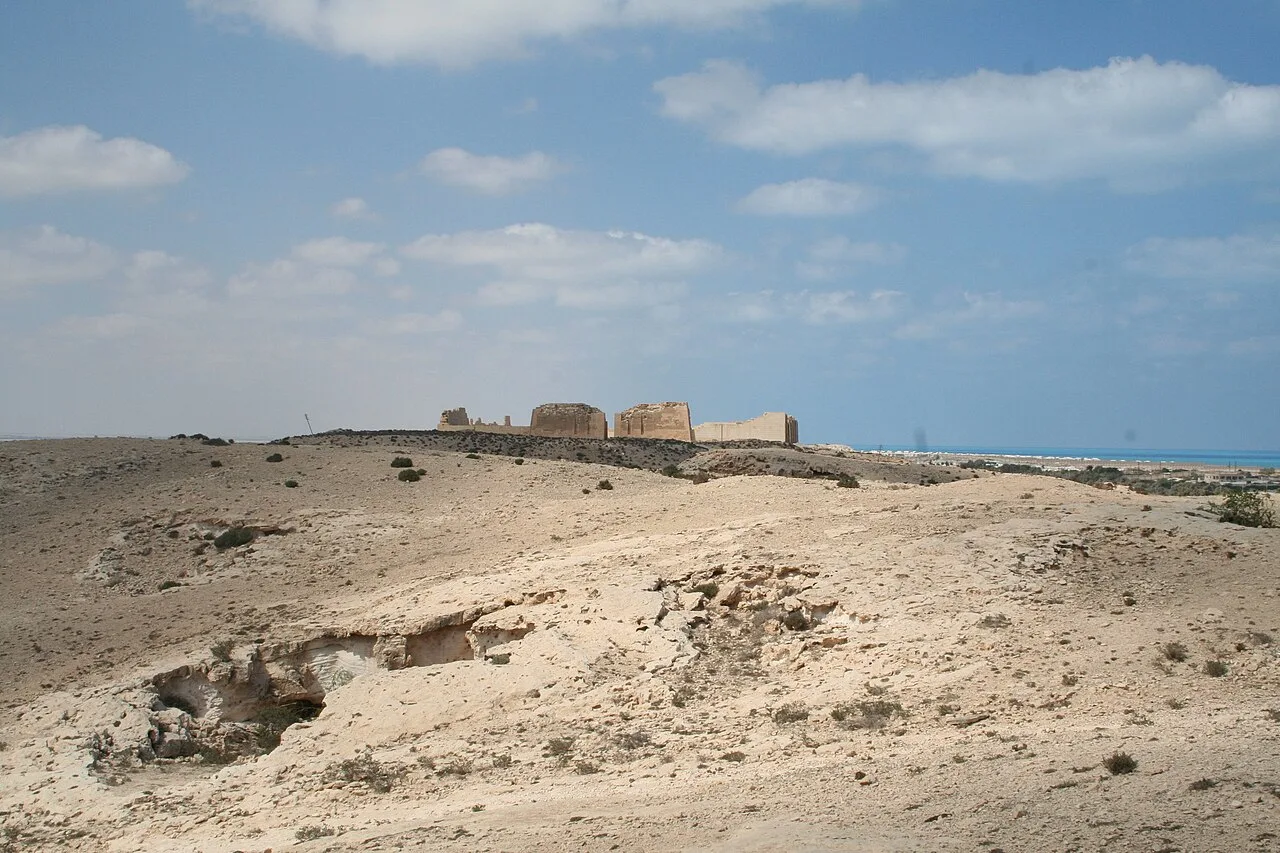
The site of a Ptolemaic and Roman Red Sea port north of the town of Quseir, one of the harbours used for trade with India.
Myos Hormos (Ancient Greek: Μυὸς Ὅρμος), later also Aphrodites Hormos (Ἀφροδίτης ὅρμος), was a significant ancient port in Egypt, situated on the Red Sea, and was active during the Ptolemaic and Roman periods.
The settlement is believed to have been founded during the Ptolemaic period, possibly under Ptolemy II Philadelphus (283–246 BC), Excavations carried out recently by David Peacock and Lucy Blue of the University of Southampton, identified it with the present-day site of Quseir al-Quadim (old Quseir), eight kilometres north of the modern town of El Qoseir in Egypt. Excavations at the site revealed that the port thrived most during the 1st century AD, but declined by the 3rd century AD.
Etymology
The Myos Hormos may mean the "Harbour of the Mouse", but most probably meant the "Harbour of the Mussel" (μύειν, to close, e.g. the shell), since on the neighbouring coast the pearl mussel was collected in large quantities.
The port was later renamed Aphrodites Hormos (Ancient Greek: Ἀφροδίτης ὅρμος), though the original name remained more widely used. It seems to have obtained the name of Aphrodite (technically meaning foam of the sea), from the abundance of sea-sponge found in its bay.
History
Ptolemy II Philadelphus selected it for the principal harbour of the trade with India, in preference to Arsinoe, since Arsinoe was at the head of the Red Sea and there was a tedious and difficult navigation down the Heroopolite Gulf. Vessels from Myos Hormos traded with Africa, Arabia, and India.
After the Ptolemies, it was with Berenice (further south on the Red Sea coast) one of the two main ports in Roman Egypt for trade with India, Africa and probably China.
Some of its main destinations were the Indus delta, Muziris and the Kathiawar peninsula in India. The coastal trade from Myos Hormos and Berenice along the coast of the Indian Ocean is described in the anonymous 1st century AD handbook Periplus of the Erythraean Sea.
first comes Egypt's port of Myos Hormos, and beyond it, after a sail of 1800 stades to the right, Berenice. The ports of both are bays on the Red Sea on the edge of Egypt. It was one of the main trading centers on the Red Sea.
According to Strabo (II.5.12), by the time of Augustus, up to 120 ships were setting sail every year from Myos Hormos to India:
At any rate, when Gallus was prefect of Egypt, I accompanied him and ascended the Nile as far as Syene and the frontiers of Ethiopia, and I learned that as many as one hundred and twenty vessels were sailing from Myos Hormos to India, whereas formerly, under the Ptolemies, only a very few ventured to undertake the voyage and to carry on traffic in Indian merchandise.
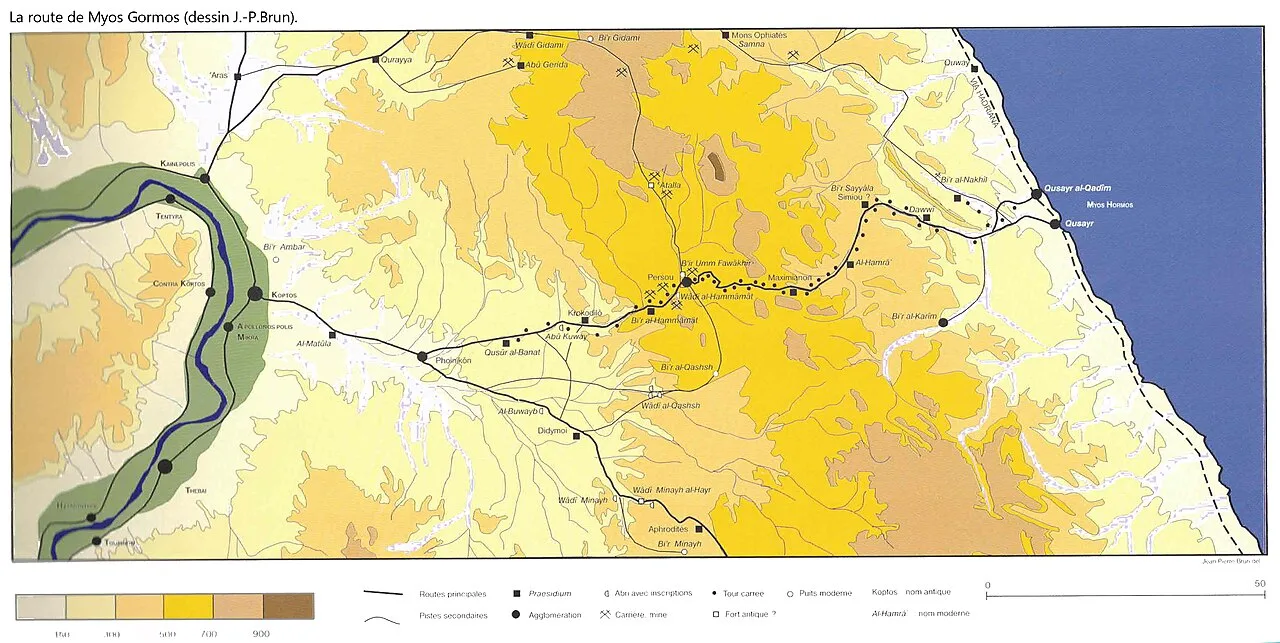
The port of Myos Hormos was connected to the Nile valley and Memphis by a Roman road, built in the 1st century.
Myos Hormos was a diverse, multi-ethnic community, as evidenced by the various languages spoken and the presence of foreign residents.
Source: Wikipedia · text available under CC BY-SA 4.0
- Location
- El Quseir, Egypt
- Coordinates
- 26.1564, 34.2422
- Category
- Ancient Sites
Source: Wikipedia · Factual information about the real landmark; unrelated to virtual ownership.