Sabil-Kuttab of Katkhuda
Virtual asset linked to this landmark

- Virtual owner
- The platform
- Times sold
- 0
- Fame on Wikipedia
- 749 article reads in 12 months
- Searches (30 days)
- 0
- Watching
- 0
Virtual ownership only. It gives no legal, financial or physical right in the real landmark. Prices are set by the market and may fall.
About Sabil-Kuttab of Katkhuda and its history
An Ottoman-era public fountain and school on al-Muizz Street, built in 1744.
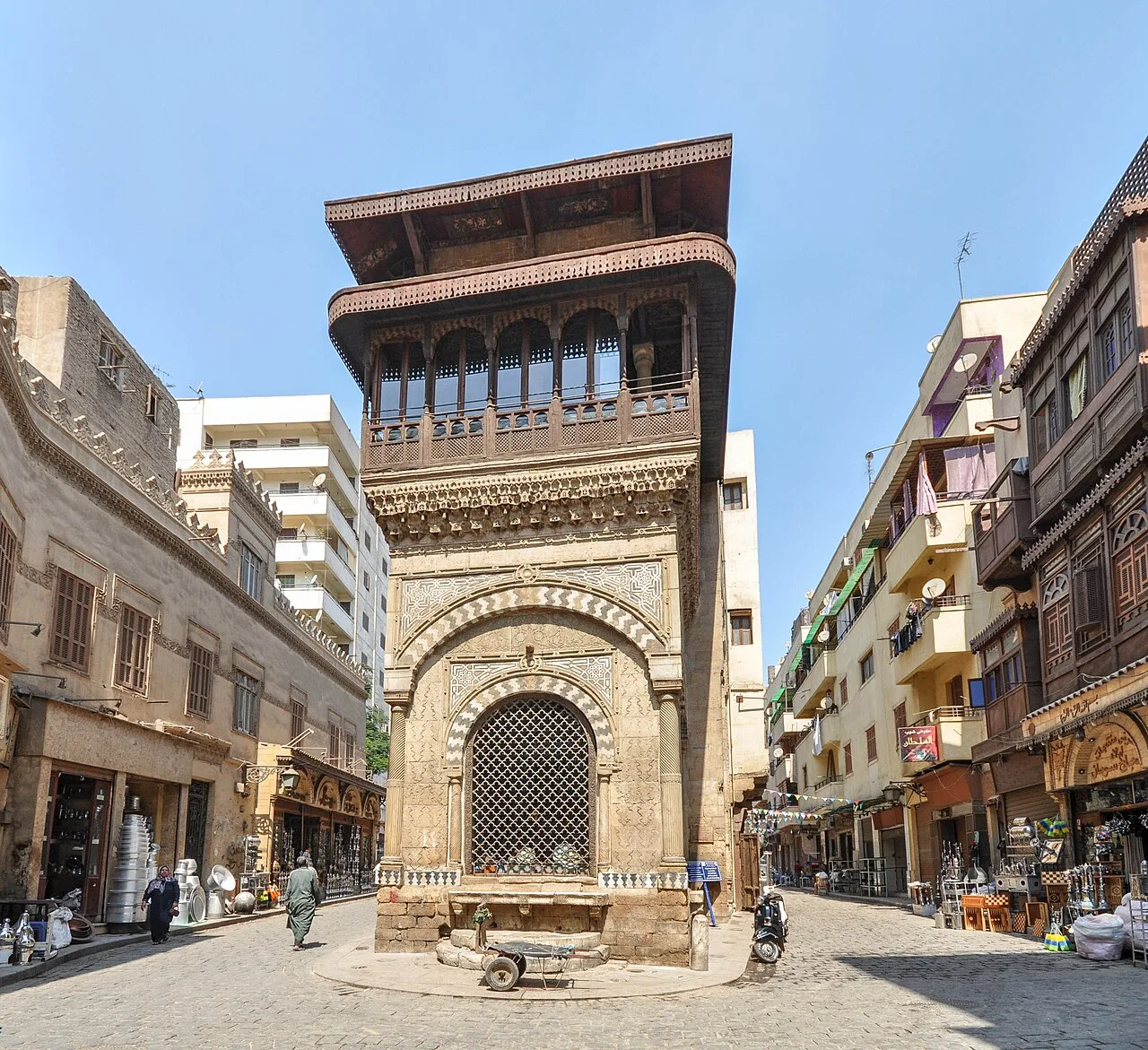
Sabil-Kuttab of Abd al-Rahman Katkhuda (Arabic: سبيل وكتاب عبدالرحمن كتخدا) is a historic monument in the historic district of Cairo, Egypt. It comprises a public fountain or sabil, an elementary Quran school or kuttab, and an adjacent residential wing. A prime example of Egyptian architecture of its time, it was commissioned in 1744 by Abd al-Rahman Katkhuda, a local official who was a prominent patron of architecture.
Historical overview
Sabil-Kuttab of Katkhuda is an important monument in Cairo, located on Al-Muizz Street. Built in 1744 CE, it is named for its patron, a Mamluk amir (prince) and leader of the Egyptian Janissaries, who died in 1776. He did much work in Cairo including developments to Al-Azhar University and mosque. He also rebuilt the dome of the Qala'un Mosque after an earthquake in Egypt.
Sabils and kuttabs were almost everywhere in old Islamic Cairo during Mamluk and Ottoman times. Sabils are facilities providing free, fresh water for thirsty people who are passing by. Kuttabs are primitive kinds of elementary schools that teach children to read and write.
The Sabil-Kuttab was built using the Mamluk Egyptian style which continued to overwhelm all the styles of such buildings even after the Ottoman conquest in 1517. The architecture of this time was so delicate that even simple facilities like sabils were designed to be pieces of art.
Architecture
The Sabil-Kuttab was built to achieve the maximum available visibility in Al-Muizz Street. This was achieved through building it with three free-standing sides.
The building consists of two main parts. The southern part is two stories high and contains the sabil and the kuttab from which it derives its name. The northern part is not registered and is being used now as living apartments. Sabil is an Arabic word for the place or the building which offers free fresh drinking water to passers-by or whoever asks for it. A kuttab is a place which provides elementary education for children. It was very common in old Islamic Egypt. Kuttabs are still available as an activity of some mosques to teach the children the Quran.
The building is open on three sides and consists of grey and white stones inlaid with marble reliefs. There are also, tiles with embedded pillars at its corners.
The entrance of the Sabil has artistic writings which are verses from the Quran about "Ahl Al-Kahf". This is commonly seen in Katkhuda's buildings.
The kuttab is located on the second floor and is composed of five marbled columns holding the painted roof. The windows are wooden and have beautiful artistic design. This type of window is called "mashrabeyya", which is characteristic of almost all buildings of Islamic Cairo. The door and the cupboards are wooden and are carved and painted.
The structure sits on a triangular site formed by the splitting of Al-Muizz Street into two branches.
Source: Wikipedia · text available under CC BY-SA 4.0
- Location
- Cairo, Egypt
- Coordinates
- 30.0508, 31.2617
- Category
- Historic Landmarks
Source: Wikipedia · Factual information about the real landmark; unrelated to virtual ownership.
Price & ownership history
Landmarks near Sabil-Kuttab of Katkhuda
Map → Available
📖 84 K reads
Available
📖 84 K reads
 Available
📖 1 K reads
Available
📖 1 K reads
 Available
📖 7 K reads
Available
📖 7 K reads
 Available
📖 8 K reads
Available
📖 8 K reads