Egyptian Museum (Tahrir)
Virtual asset linked to this landmark

- Virtual owner
- The platform
- Times sold
- 0
- Fame on Wikipedia
- 91,800 article reads in 12 months
- Searches (30 days)
- 0
- Watching
- 0
Virtual ownership only. It gives no legal, financial or physical right in the real landmark. Prices are set by the market and may fall.
About Egyptian Museum (Tahrir) and its history
A museum in downtown Cairo holding one of the world's largest collections of ancient Egyptian antiquities.
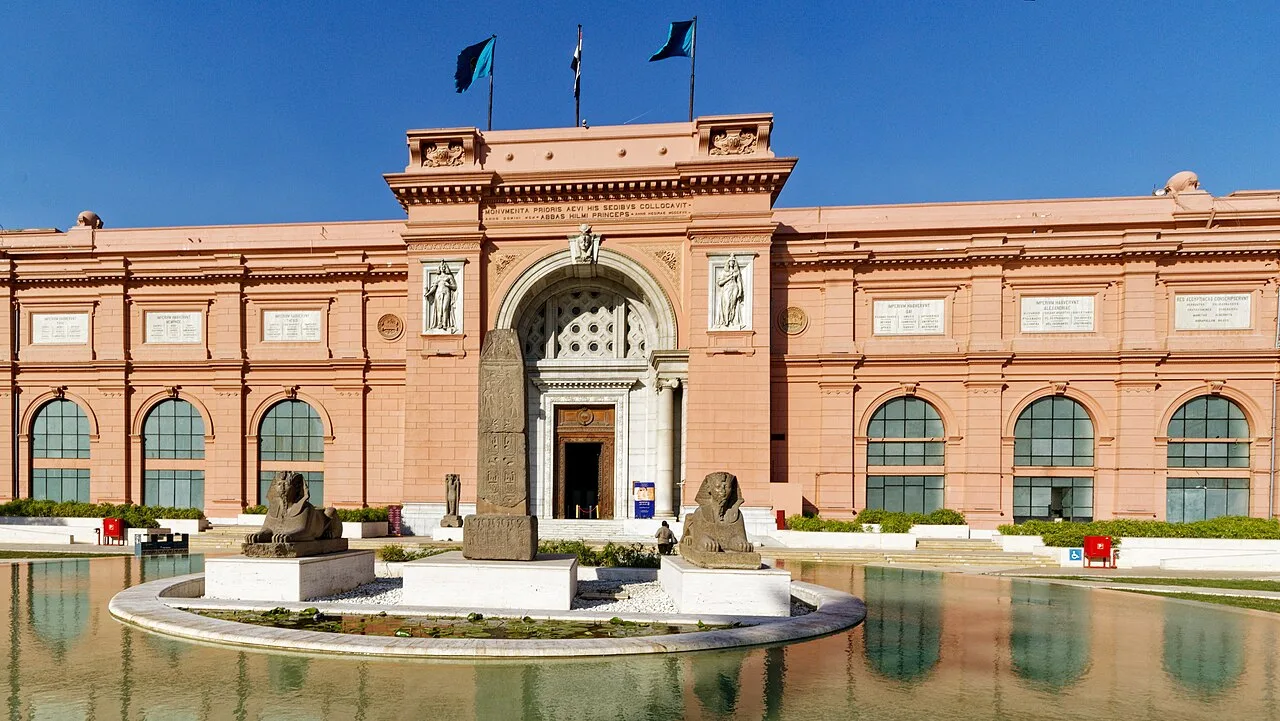
The Museum of Egyptian Antiquities, commonly known as the Egyptian Museum (Egyptian Arabic: المتحف المصرى, romanized: al-Matḥaf al-Miṣrī, Egyptian Arabic pronunciation: [elˈmætħæf elˈmɑsˤɾi]) and also called the Cairo Museum or the Egyptian Museum in Cairo (EMC), is a national history museum in Cairo, Egypt.
An Egyptological museum, it houses the largest collection of Egyptian antiquities in the world, including over 170,000 items. The Egyptian Museum occupies a building constructed in 1901 on Tahrir Square and is one of the largest museums in Africa as well as the first national museum of the Middle East.
The Egyptian government established a museum in 1835 near the Ezbekieh Garden.
Youssef Diaa Effendi, the director of the Antiquities Department, began inspecting the antiquities of Middle Egypt shortly after assuming his position, focusing on those discovered by farmers. In 1848, Muhammad Ali Pasha assigned Linan Bek, the Minister of Education, to compile a report on archaeological sites and send artifacts to the Egyptian Museum. However, this effort was not successful due to the death of Muhammad Ali Pasha in 1849, followed by a period of instability. The trade in antiquities resurfaced, and the collection housed in the museum established in Azbakeya began to shrink until it was transferred to a single hall in the Cairo Citadel. The situation worsened when Khedive Abbas I donated the entire contents of this hall to Archduke Maximilian of Austria during his visit to the citadel in 1855; these are now in the Kunsthistorisches Museum, Vienna.
Following the foundation of the new Antiquities Department under the direction of Auguste Mariette, a new museum was established in 1858 at Boulaq in a former warehouse on the riverbank. Mariette considered the Boulaq Museum a temporary location, and after the building was damaged in an 1878 Nile flood, he advocated for a permanent museum with greater capacity, situated away from the flood path. After Mariette's death, he was succeeded by Gaston Maspero, who attempted to move the museum from Boulaq but was unsuccessful. By 1889, the building was overcrowded, with no available rooms for more artifacts in either the exhibition halls or storage areas. Artifacts discovered during excavations were often left for long periods in boats in Upper Egypt. Khedive Ismail offered one of his palaces in Giza, the location of the present-day zoo, to serve as the new museum. Between the summer and the end of 1889, all the artifacts were moved from the Boulaq Museum to Giza, and the artifacts were reorganized in the new museum by the scholar De Morgan, who served as the museum's director. From 1897 to 1899, Loret succeeded De Morgan, but Maspero returned to manage the museum from 1899 to 1914.
The artifacts remained there until 1902 when they were moved again to the current museum in Tahrir Square, built by the Italian company of Giuseppe Garozzo and Francesco Zaffrani to a design by the French architect Marcel Dourgnon.
Source: Wikipedia · text available under CC BY-SA 4.0
- Built / established
- Current building opened in 1902
- Location
- Cairo, Egypt
- Coordinates
- 30.0478, 31.2336
- Category
- Museums
Key facts
- Its building was designed by the French architect Marcel Dourgnon.
Source: Wikipedia · Factual information about the real landmark; unrelated to virtual ownership.
Price & ownership history
Landmarks near Egyptian Museum (Tahrir)
Map → Available
📖 8 K reads
Available
📖 8 K reads
 Available
📖 1 K reads
Available
📖 1 K reads
 Available
📖 1 K reads
Available
📖 1 K reads
 Available
📖 7 K reads
Available
📖 7 K reads