Empty Quarter (Rub' al Khali)
Virtual asset linked to this landmark

- Virtual owner
- The platform
- Times sold
- 0
- Fame on Wikipedia
- 140,887 article reads in 12 months
- Searches (30 days)
- 0
- Watching
- 0
Virtual ownership only. It gives no legal, financial or physical right in the real landmark. Prices are set by the market and may fall.
About Empty Quarter (Rub' al Khali) and its history
The largest continuous sand desert in the world.
The Rub' al Khali (; Arabic: ٱلرُّبْع ٱلْخَالِي, lit. 'Empty Quarter', [ar.rʊbʕ‿al.χaːliː]) is a desert encompassing most of the southern third of the Arabian Peninsula. The desert covers some 650,000 km2 (250,000 sq mi), including parts of Saudi Arabia, Oman, the United Arab Emirates, and Yemen. It is part of the larger Arabian Desert.
The desert is 1,000 kilometres (620 miles) long, and 500 kilometres (310 miles) wide, covering the area of longitude 44.5°−56.5°E and latitude 16.5°−23.0°N. Its surface elevation varies from 800 metres (2,600 ft) in the southwest to around sea level in the northeast. Most of the terrain is ergs, with sand dunes up to 250 metres (820 ft) high, interspersed with gravel and gypsum plains. The sand is reddish-orange due to the presence of feldspar.
There are also brackish salt flats in some areas, such as the Umm al Samim area on the desert's eastern edge. Ali Al-Naimi reports that the sand dunes do not drift. He goes on to say,
Sand blows off the surface, of course, but the essential shape of the dunes remains intact, probably due to the moisture leaching up into the base of the dunes from the surrounding sabkhas.
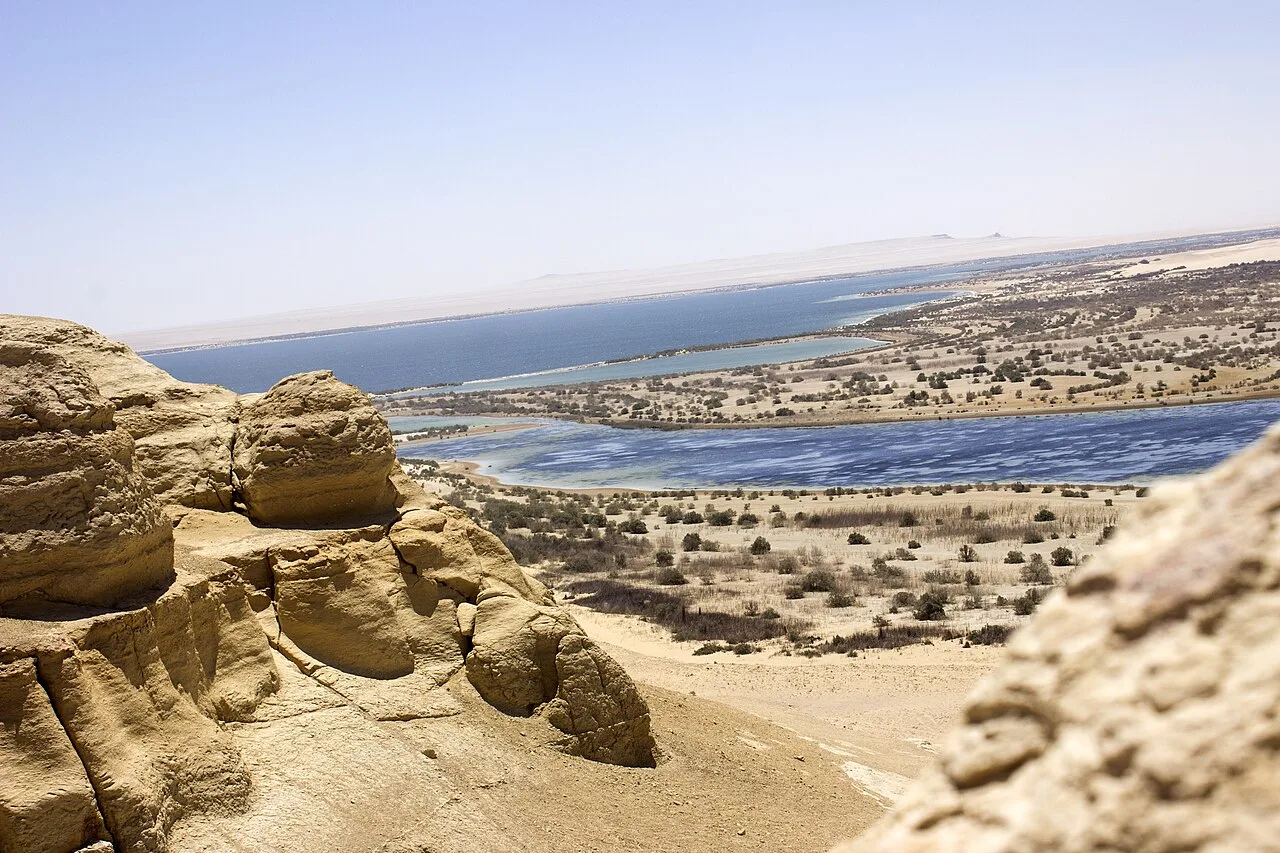
Along the middle length of the desert, there are several raised, hardened areas of calcium carbonate, gypsum, marl, or clay that were once the site of shallow lakes. These lakes existed during periods from 6,000 to 5,000 years ago and 3,000 to 2,000 years ago. The lakes are thought to have formed as a result of "cataclysmic rainfall" similar to present-day monsoon rains and most probably lasted for only a few years. However, lakes in the Mundafen area in the southwest of the Rub' al Khali show evidence of such lakes lasting longer, up to 800 years, from increased runoff from the Tuwaiq Escarpment.
Evidence suggests that the lakes were home to a variety of flora and fauna. Fossil remains indicate the presence of several animal species, such as hippopotamus, water buffalo, and long-horned cattle. The lakes also contained small snails, ostracods, and when conditions were suitable, freshwater clams. Deposits of calcium carbonate and opal phytoliths indicate the presence of plants and algae. There is also evidence of human activity dating from 3,000 to 2,000 years ago, including chipped flint tools, but no actual human remains have been found.
The region is classified as "hyper-arid", with annual precipitation generally less than 50 millimetres (2.0 in), and daily mean relative humidity of about 52% in January and 15% in June–July.
Fauna includes arachnids (e.g. scorpions) and rodents, while plants live throughout the Empty Quarter. The dromedary, or Arabian camel, is an important part of the fauna, with the black camels of Oman being a rare and prized breed. As an ecoregion, the Rub' al Khali falls within the Arabian Desert and East Saharo-Arabian xeric shrublands. The Asiatic cheetah, once widespread in Saudi Arabia, is extirpated.
Source: Wikipedia · text available under CC BY-SA 4.0
- Location
- Najran, Saudi Arabia
- Coordinates
- 19.0000, 50.0000
- Category
- Nature & Parks
Source: Wikipedia · Factual information about the real landmark; unrelated to virtual ownership.